


Page 99 - C-Language
P. 99
print_strings(strings, 4);
                                ^
         file1.c:3:10: note: expected 'char **' but argument is of type 'char (*)[20]'
              void print_strings(char **strings, size_t n)


        The error states that the s array in the main function is passed to the function print_strings, which
        expects a different pointer type than it received. It also includes a note expressing the type that is
        expected by print_strings and the type that was passed to it from main.

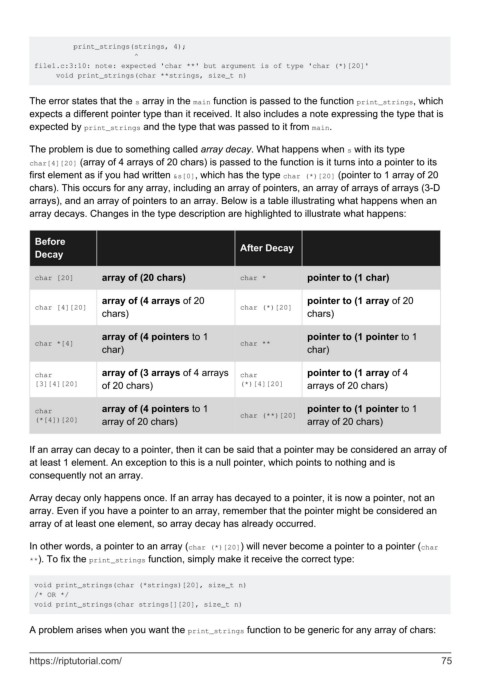
        The problem is due to something called array decay. What happens when s with its type
        char[4][20] (array of 4 arrays of 20 chars) is passed to the function is it turns into a pointer to its
        first element as if you had written &s[0], which has the type char (*)[20] (pointer to 1 array of 20
        chars). This occurs for any array, including an array of pointers, an array of arrays of arrays (3-D
        arrays), and an array of pointers to an array. Below is a table illustrating what happens when an
        array decays. Changes in the type description are highlighted to illustrate what happens:


          Before
                                                             After Decay
          Decay

          char [20]       array of (20 chars)                char *          pointer to (1 char)


                          array of (4 arrays of 20                           pointer to (1 array of 20
          char [4][20]                                       char (*)[20]
                          chars)                                             chars)


                          array of (4 pointers to 1                          pointer to (1 pointer to 1
          char *[4]                                          char **
                          char)                                              char)


          char            array of (3 arrays of 4 arrays     char            pointer to (1 array of 4
          [3][4][20]      of 20 chars)                       (*)[4][20]      arrays of 20 chars)


          char            array of (4 pointers to 1                          pointer to (1 pointer to 1
          (*[4])[20]      array of 20 chars)                 char (**)[20]   array of 20 chars)


        If an array can decay to a pointer, then it can be said that a pointer may be considered an array of
        at least 1 element. An exception to this is a null pointer, which points to nothing and is
        consequently not an array.


        Array decay only happens once. If an array has decayed to a pointer, it is now a pointer, not an
        array. Even if you have a pointer to an array, remember that the pointer might be considered an
        array of at least one element, so array decay has already occurred.

        In other words, a pointer to an array (char (*)[20]) will never become a pointer to a pointer (char
        **). To fix the print_strings function, simply make it receive the correct type:


         void print_strings(char (*strings)[20], size_t n)
         /* OR */
         void print_strings(char strings[][20], size_t n)


        A problem arises when you want the print_strings function to be generic for any array of chars:


        https://riptutorial.com/                                                                               75

