


Page 101 - C-Language
P. 101
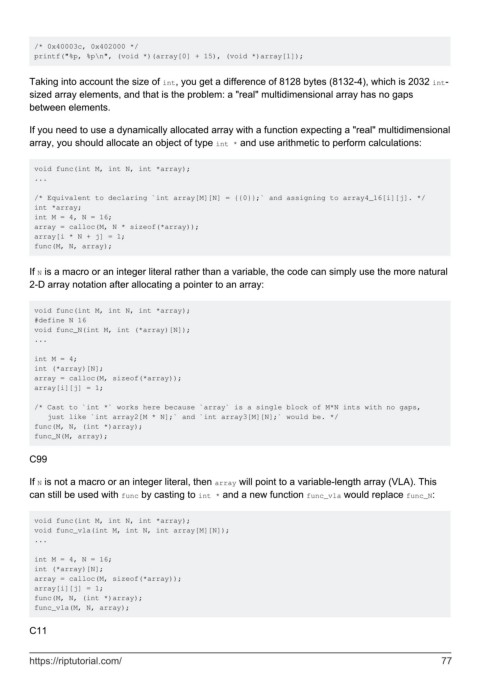
/* 0x40003c, 0x402000 */
         printf("%p, %p\n", (void *)(array[0] + 15), (void *)array[1]);


        Taking into account the size of int, you get a difference of 8128 bytes (8132-4), which is 2032 int-
        sized array elements, and that is the problem: a "real" multidimensional array has no gaps
        between elements.


        If you need to use a dynamically allocated array with a function expecting a "real" multidimensional
        array, you should allocate an object of type int * and use arithmetic to perform calculations:


         void func(int M, int N, int *array);
         ...

         /* Equivalent to declaring `int array[M][N] = {{0}};` and assigning to array4_16[i][j]. */
         int *array;
         int M = 4, N = 16;
         array = calloc(M, N * sizeof(*array));
         array[i * N + j] = 1;
         func(M, N, array);


        If N is a macro or an integer literal rather than a variable, the code can simply use the more natural
        2-D array notation after allocating a pointer to an array:


         void func(int M, int N, int *array);
         #define N 16
         void func_N(int M, int (*array)[N]);
         ...

         int M = 4;
         int (*array)[N];
         array = calloc(M, sizeof(*array));
         array[i][j] = 1;

         /* Cast to `int *` works here because `array` is a single block of M*N ints with no gaps,
            just like `int array2[M * N];` and `int array3[M][N];` would be. */
         func(M, N, (int *)array);
         func_N(M, array);


        C99

        If N is not a macro or an integer literal, then array will point to a variable-length array (VLA). This
        can still be used with func by casting to int * and a new function func_vla would replace func_N:


         void func(int M, int N, int *array);
         void func_vla(int M, int N, int array[M][N]);
         ...

         int M = 4, N = 16;
         int (*array)[N];
         array = calloc(M, sizeof(*array));
         array[i][j] = 1;
         func(M, N, (int *)array);
         func_vla(M, N, array);

        C11


        https://riptutorial.com/                                                                               77

