


Page 94 - C-Language
P. 94
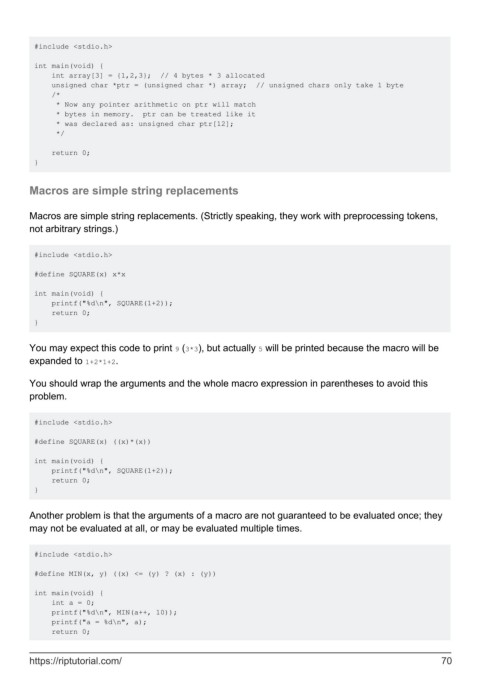
#include <stdio.h>

         int main(void) {
             int array[3] = {1,2,3};  // 4 bytes * 3 allocated
             unsigned char *ptr = (unsigned char *) array;  // unsigned chars only take 1 byte
             /*
              * Now any pointer arithmetic on ptr will match
              * bytes in memory.  ptr can be treated like it
              * was declared as: unsigned char ptr[12];
              */

             return 0;
         }


        Macros are simple string replacements


        Macros are simple string replacements. (Strictly speaking, they work with preprocessing tokens,
        not arbitrary strings.)


         #include <stdio.h>

         #define SQUARE(x) x*x

         int main(void) {
             printf("%d\n", SQUARE(1+2));
             return 0;
         }


        You may expect this code to print 9 (3*3), but actually 5 will be printed because the macro will be
        expanded to 1+2*1+2.


        You should wrap the arguments and the whole macro expression in parentheses to avoid this
        problem.


         #include <stdio.h>

         #define SQUARE(x) ((x)*(x))

         int main(void) {
             printf("%d\n", SQUARE(1+2));
             return 0;
         }


        Another problem is that the arguments of a macro are not guaranteed to be evaluated once; they
        may not be evaluated at all, or may be evaluated multiple times.


         #include <stdio.h>

         #define MIN(x, y) ((x) <= (y) ? (x) : (y))

         int main(void) {
             int a = 0;
             printf("%d\n", MIN(a++, 10));
             printf("a = %d\n", a);
             return 0;


        https://riptutorial.com/                                                                               70

