


Page 68 - C-Language
P. 68
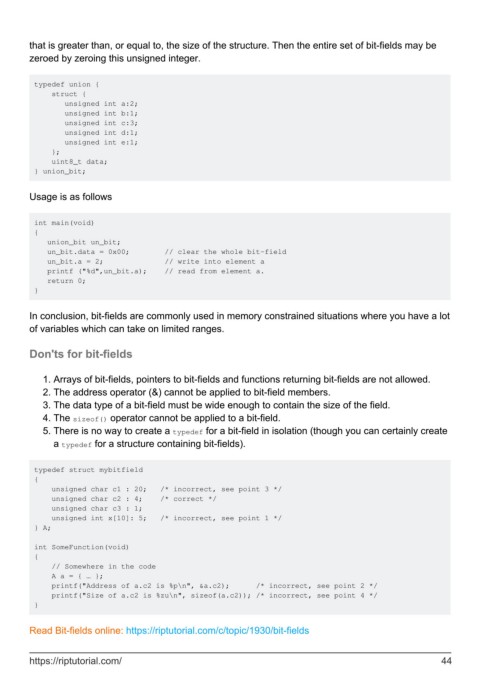
that is greater than, or equal to, the size of the structure. Then the entire set of bit-fields may be
        zeroed by zeroing this unsigned integer.


         typedef union {
             struct {
                unsigned int a:2;
                unsigned int b:1;
                unsigned int c:3;
                unsigned int d:1;
                unsigned int e:1;
             };
             uint8_t data;
         } union_bit;


        Usage is as follows


         int main(void)
         {
            union_bit un_bit;
            un_bit.data = 0x00;        // clear the whole bit-field
            un_bit.a = 2;              // write into element a
            printf ("%d",un_bit.a);    // read from element a.
            return 0;
         }


        In conclusion, bit-fields are commonly used in memory constrained situations where you have a lot
        of variables which can take on limited ranges.


        Don'ts for bit-fields


            1.  Arrays of bit-fields, pointers to bit-fields and functions returning bit-fields are not allowed.
            2.  The address operator (&) cannot be applied to bit-field members.
            3.  The data type of a bit-field must be wide enough to contain the size of the field.
            4.  The sizeof() operator cannot be applied to a bit-field.
            5.  There is no way to create a typedef for a bit-field in isolation (though you can certainly create
              a typedef for a structure containing bit-fields).


         typedef struct mybitfield
         {
             unsigned char c1 : 20;   /* incorrect, see point 3 */
             unsigned char c2 : 4;    /* correct */
             unsigned char c3 : 1;
             unsigned int x[10]: 5;   /* incorrect, see point 1 */
         } A;

         int SomeFunction(void)
         {
             // Somewhere in the code
             A a = { … };
             printf("Address of a.c2 is %p\n", &a.c2);      /* incorrect, see point 2 */
             printf("Size of a.c2 is %zu\n", sizeof(a.c2)); /* incorrect, see point 4 */
         }


        Read Bit-fields online: https://riptutorial.com/c/topic/1930/bit-fields


        https://riptutorial.com/                                                                               44

