


Page 66 - C-Language
P. 66
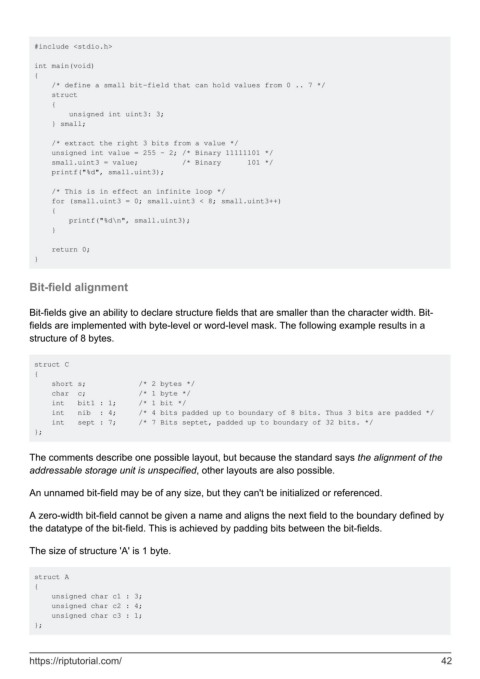
#include <stdio.h>

         int main(void)
         {
             /* define a small bit-field that can hold values from 0 .. 7 */
             struct
             {
                 unsigned int uint3: 3;
             } small;

             /* extract the right 3 bits from a value */
             unsigned int value = 255 - 2; /* Binary 11111101 */
             small.uint3 = value;          /* Binary      101 */
             printf("%d", small.uint3);

             /* This is in effect an infinite loop */
             for (small.uint3 = 0; small.uint3 < 8; small.uint3++)
             {
                 printf("%d\n", small.uint3);
             }

             return 0;
         }


        Bit-field alignment


        Bit-fields give an ability to declare structure fields that are smaller than the character width. Bit-
        fields are implemented with byte-level or word-level mask. The following example results in a
        structure of 8 bytes.


         struct C
         {
             short s;            /* 2 bytes */
             char  c;            /* 1 byte */
             int   bit1 : 1;     /* 1 bit */
             int   nib  : 4;     /* 4 bits padded up to boundary of 8 bits. Thus 3 bits are padded */
             int   sept : 7;     /* 7 Bits septet, padded up to boundary of 32 bits. */
         };


        The comments describe one possible layout, but because the standard says the alignment of the
        addressable storage unit is unspecified, other layouts are also possible.


        An unnamed bit-field may be of any size, but they can't be initialized or referenced.

        A zero-width bit-field cannot be given a name and aligns the next field to the boundary defined by
        the datatype of the bit-field. This is achieved by padding bits between the bit-fields.


        The size of structure 'A' is 1 byte.


         struct A
         {
             unsigned char c1 : 3;
             unsigned char c2 : 4;
             unsigned char c3 : 1;
         };


        https://riptutorial.com/                                                                               42

