


Page 50 - C-Language
P. 50
#define ARRLEN 10000
         int array[ARRLEN][ARRLEN];

         size_t i, j;
         for (i = 0; i < ARRLEN; ++i)
         {
             for(j = 0; j < ARRLEN; ++j)
             {
                 array[i][j] = 0;
             }
         }


        In the same vein, this is why when dealing with an array with one dimension and multiple indexes
        (let's say 2 dimensions here for simplicity with indexes i and j) it is important to iterate through the
        array like this:


         #define DIM_X 10
         #define DIM_Y 20

         int array[DIM_X*DIM_Y];

         size_t i, j;
         for (i = 0; i < DIM_X; ++i)
         {
             for(j = 0; j < DIM_Y; ++j)
             {
                 array[i*DIM_Y+j] = 0;
             }
         }


        Or with 3 dimensions and indexes i,j and k:


         #define DIM_X 10
         #define DIM_Y 20
         #define DIM_Z 30

         int array[DIM_X*DIM_Y*DIM_Z];

         size_t i, j, k;
         for (i = 0; i < DIM_X; ++i)
         {
             for(j = 0; j < DIM_Y; ++j)
             {
                 for (k = 0; k < DIM_Z; ++k)
                 {
                     array[i*DIM_Y*DIM_Z+j*DIM_Z+k] = 0;
                 }
             }
         }


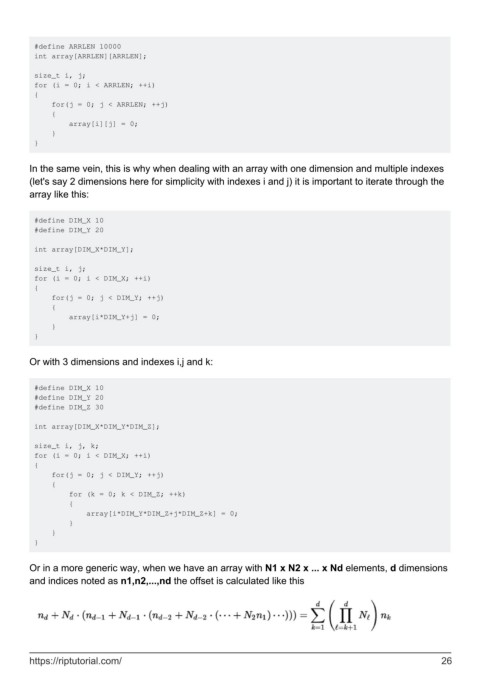
        Or in a more generic way, when we have an array with N1 x N2 x ... x Nd elements, d dimensions
        and indices noted as n1,n2,...,nd the offset is calculated like this


        https://riptutorial.com/                                                                               26

