


Page 177 - C-Language
P. 177
friend_indexes[i] = 1;
           }
         }


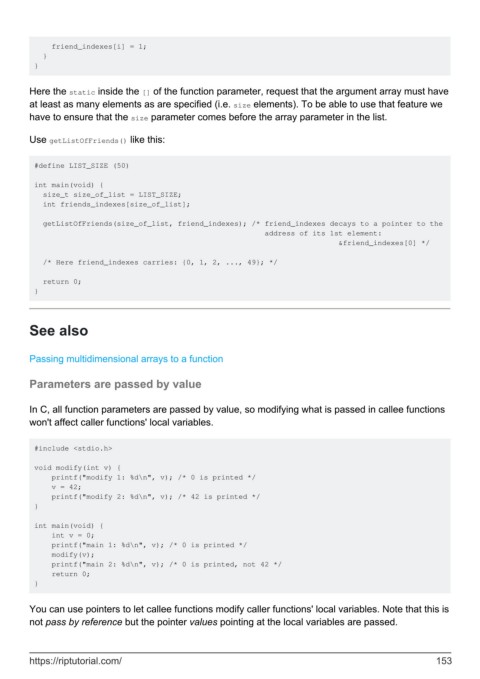
        Here the static inside the [] of the function parameter, request that the argument array must have
        at least as many elements as are specified (i.e. size elements). To be able to use that feature we
        have to ensure that the size parameter comes before the array parameter in the list.

        Use getListOfFriends() like this:


         #define LIST_SIZE (50)

         int main(void) {
           size_t size_of_list = LIST_SIZE;
           int friends_indexes[size_of_list];

           getListOfFriends(size_of_list, friend_indexes); /* friend_indexes decays to a pointer to the
                                                              address of its 1st element:
                                                                               &friend_indexes[0] */

           /* Here friend_indexes carries: {0, 1, 2, ..., 49}; */

           return 0;
         }


        See also


        Passing multidimensional arrays to a function


        Parameters are passed by value


        In C, all function parameters are passed by value, so modifying what is passed in callee functions
        won't affect caller functions' local variables.


         #include <stdio.h>

         void modify(int v) {
             printf("modify 1: %d\n", v); /* 0 is printed */
             v = 42;
             printf("modify 2: %d\n", v); /* 42 is printed */
         }

         int main(void) {
             int v = 0;
             printf("main 1: %d\n", v); /* 0 is printed */
             modify(v);
             printf("main 2: %d\n", v); /* 0 is printed, not 42 */
             return 0;
         }


        You can use pointers to let callee functions modify caller functions' local variables. Note that this is
        not pass by reference but the pointer values pointing at the local variables are passed.


        https://riptutorial.com/                                                                             153

