


Page 171 - C-Language
P. 171
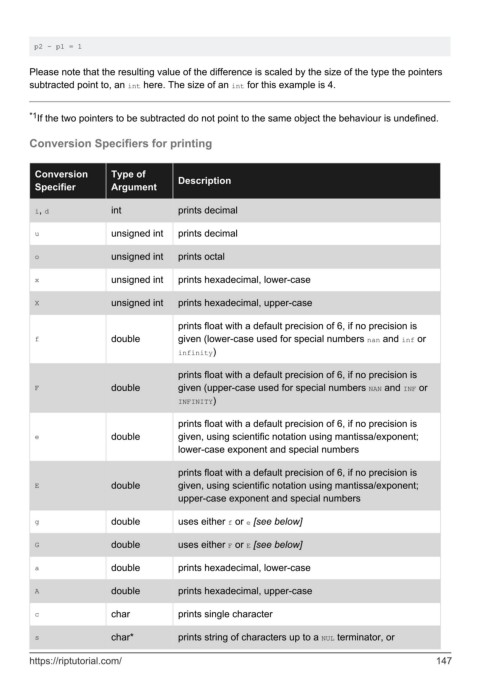
p2 - p1 = 1


        Please note that the resulting value of the difference is scaled by the size of the type the pointers
        subtracted point to, an int here. The size of an int for this example is 4.


        *1 If the two pointers to be subtracted do not point to the same object the behaviour is undefined.


        Conversion Specifiers for printing


          Conversion         Type of
                                             Description
          Specifier          Argument


          i, d               int             prints decimal


          u                  unsigned int    prints decimal

          o                  unsigned int    prints octal


          x                  unsigned int    prints hexadecimal, lower-case

          X                  unsigned int    prints hexadecimal, upper-case


                                             prints float with a default precision of 6, if no precision is
          f                  double          given (lower-case used for special numbers nan and inf or
                                             infinity)


                                             prints float with a default precision of 6, if no precision is
          F                  double          given (upper-case used for special numbers NAN and INF or
                                             INFINITY)

                                             prints float with a default precision of 6, if no precision is
          e                  double          given, using scientific notation using mantissa/exponent;
                                             lower-case exponent and special numbers


                                             prints float with a default precision of 6, if no precision is
          E                  double          given, using scientific notation using mantissa/exponent;
                                             upper-case exponent and special numbers

          g                  double          uses either f or e [see below]


          G                  double          uses either F or E [see below]


          a                  double          prints hexadecimal, lower-case

          A                  double          prints hexadecimal, upper-case


          c                  char            prints single character

          s                  char*           prints string of characters up to a NUL terminator, or


        https://riptutorial.com/                                                                             147

