


Page 108 - C-Language
P. 108
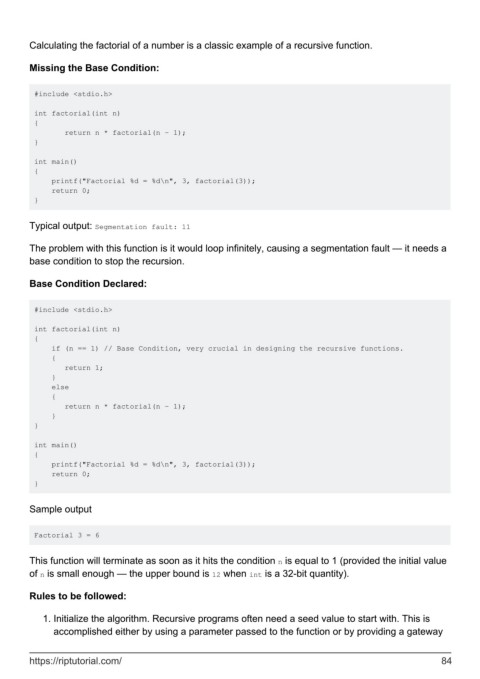
Calculating the factorial of a number is a classic example of a recursive function.


        Missing the Base Condition:


         #include <stdio.h>

         int factorial(int n)
         {
                return n * factorial(n - 1);
         }

         int main()
         {
             printf("Factorial %d = %d\n", 3, factorial(3));
             return 0;
         }


        Typical output: Segmentation fault: 11


        The problem with this function is it would loop infinitely, causing a segmentation fault — it needs a
        base condition to stop the recursion.

        Base Condition Declared:


         #include <stdio.h>

         int factorial(int n)
         {
             if (n == 1) // Base Condition, very crucial in designing the recursive functions.
             {
                return 1;
             }
             else
             {
                return n * factorial(n - 1);
             }
         }

         int main()
         {
             printf("Factorial %d = %d\n", 3, factorial(3));
             return 0;
         }


        Sample output


         Factorial 3 = 6


        This function will terminate as soon as it hits the condition n is equal to 1 (provided the initial value
        of n is small enough — the upper bound is 12 when int is a 32-bit quantity).


        Rules to be followed:

            1.  Initialize the algorithm. Recursive programs often need a seed value to start with. This is
              accomplished either by using a parameter passed to the function or by providing a gateway


        https://riptutorial.com/                                                                               84

