


Page 107 - C-Language
P. 107
return max;
         }
         #endif


        Some guides go so far as to recommend that code sections must never be commented and that if
        code is to be temporarily disabled one could resort to using an #if 0 directive.

        See #if 0 to block out code sections.


        Overstepping array boundaries


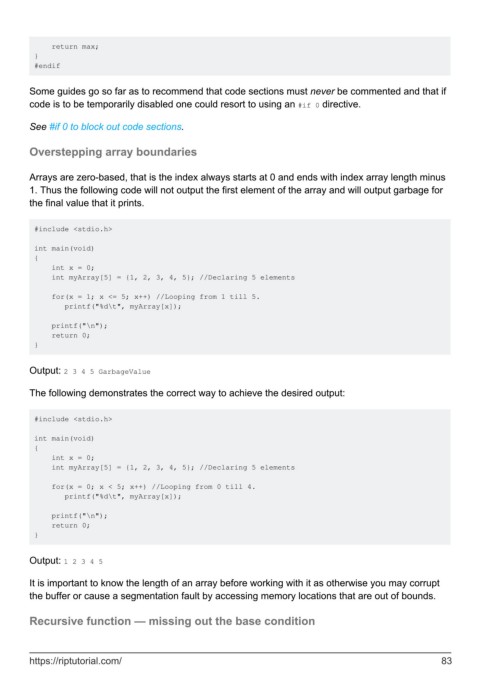
        Arrays are zero-based, that is the index always starts at 0 and ends with index array length minus
        1. Thus the following code will not output the first element of the array and will output garbage for
        the final value that it prints.


         #include <stdio.h>

         int main(void)
         {
             int x = 0;
             int myArray[5] = {1, 2, 3, 4, 5}; //Declaring 5 elements

             for(x = 1; x <= 5; x++) //Looping from 1 till 5.
                printf("%d\t", myArray[x]);

             printf("\n");
             return 0;
         }


        Output: 2 3 4 5 GarbageValue

        The following demonstrates the correct way to achieve the desired output:


         #include <stdio.h>

         int main(void)
         {
             int x = 0;
             int myArray[5] = {1, 2, 3, 4, 5}; //Declaring 5 elements

             for(x = 0; x < 5; x++) //Looping from 0 till 4.
                printf("%d\t", myArray[x]);

             printf("\n");
             return 0;
         }


        Output: 1 2 3 4 5


        It is important to know the length of an array before working with it as otherwise you may corrupt
        the buffer or cause a segmentation fault by accessing memory locations that are out of bounds.


        Recursive function — missing out the base condition


        https://riptutorial.com/                                                                               83

