


Page 40 - C-Language
P. 40
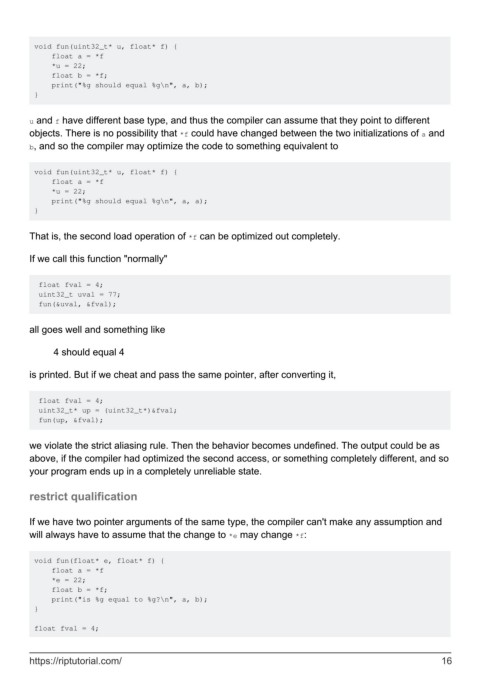
void fun(uint32_t* u, float* f) {
             float a = *f
             *u = 22;
             float b = *f;
             print("%g should equal %g\n", a, b);
         }


        u and f have different base type, and thus the compiler can assume that they point to different
        objects. There is no possibility that *f could have changed between the two initializations of a and
        b, and so the compiler may optimize the code to something equivalent to


         void fun(uint32_t* u, float* f) {
             float a = *f
             *u = 22;
             print("%g should equal %g\n", a, a);
         }


        That is, the second load operation of *f can be optimized out completely.


        If we call this function "normally"


          float fval = 4;
          uint32_t uval = 77;
          fun(&uval, &fval);


        all goes well and something like


              4 should equal 4


        is printed. But if we cheat and pass the same pointer, after converting it,


          float fval = 4;
          uint32_t* up = (uint32_t*)&fval;
          fun(up, &fval);


        we violate the strict aliasing rule. Then the behavior becomes undefined. The output could be as
        above, if the compiler had optimized the second access, or something completely different, and so
        your program ends up in a completely unreliable state.


        restrict qualification


        If we have two pointer arguments of the same type, the compiler can't make any assumption and
        will always have to assume that the change to *e may change *f:


         void fun(float* e, float* f) {
             float a = *f
             *e = 22;
             float b = *f;
             print("is %g equal to %g?\n", a, b);
         }

         float fval = 4;


        https://riptutorial.com/                                                                               16

